Tableviewer
Turn every table into an Interactive Social Surface
An interactive table-top computer that hangs from the ceiling like a lamp, turning any surface into a shared social interface. A physical-computing framework for multi-user experiences, built across three hardware iterations.
The Tableviewer is a research project into accessible, familiar interfaces for a multi-touch surface ambient computer. The hardware is in its third iteration, and the software is still being tested and prototyped.
What
The Tableviewer is an interactive table-top computer system. It can be hung from the ceiling like a lamp to turn any dull surface into a sparkling social interactive interface. The contraption consists of an infrared camera, a computer, a beamer and smart software connecting those parts together. Objects on the surface underneath the Tableviewer can be turned into tangible interactive objects.
As a product it is a work in progress, currently on the third hardware iteration. At the same time it is a set of continuously improved software components, and we also offer it as a service: the system can be temporarily installed running tailor-made software for an event.
Why
We wanted a physical-computing framework for interactive social experiences. Despite the spread of digital devices in daily life – laptops, smartphones, HD displays – we still miss strong social use of these technologies in the real world. The Tableviewer is meant to act as a social bridge between the physical and the virtual.
We imagine an environment that helps ad-hoc groups who find themselves at the same venue or event compare their opinions and standpoints, and depart on a shared exploration or discussion based on the data in front of them. We would rather build for multi-user than for multi-touch as such.
Applications
The key focus is playful social exploration of shared interests, where the Tableviewer especially shines. Two applications we prototyped:
Social Music Recommendation: for Music Hack Day 2010 in Amsterdam, a concept demo where people compare their music tastes and see where they overlap and where the gaps are. The Tableviewer becomes a turn-taking jukebox with tangible interactions and visuals for users and spectators alike.
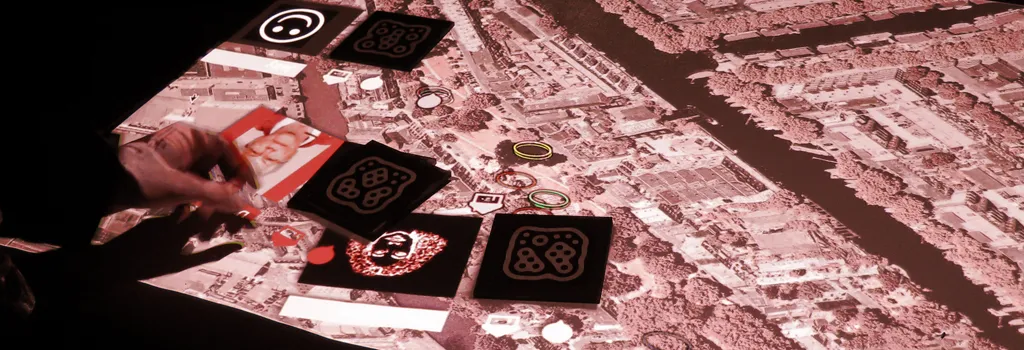
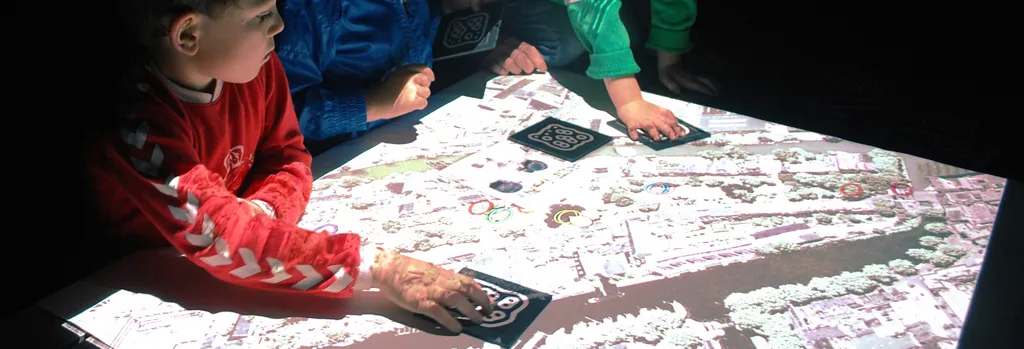
Neighbourhood Map: for the festival Nacht van het Water in Schiedam (2010), a prototype interactive map on which visitors placed their home and their favourite spot in the neighbourhood. The table’s interactive behaviour and meaningful visuals sparked lively discussion among participants.
The Tableviewer has its own home at tableviewer.com.